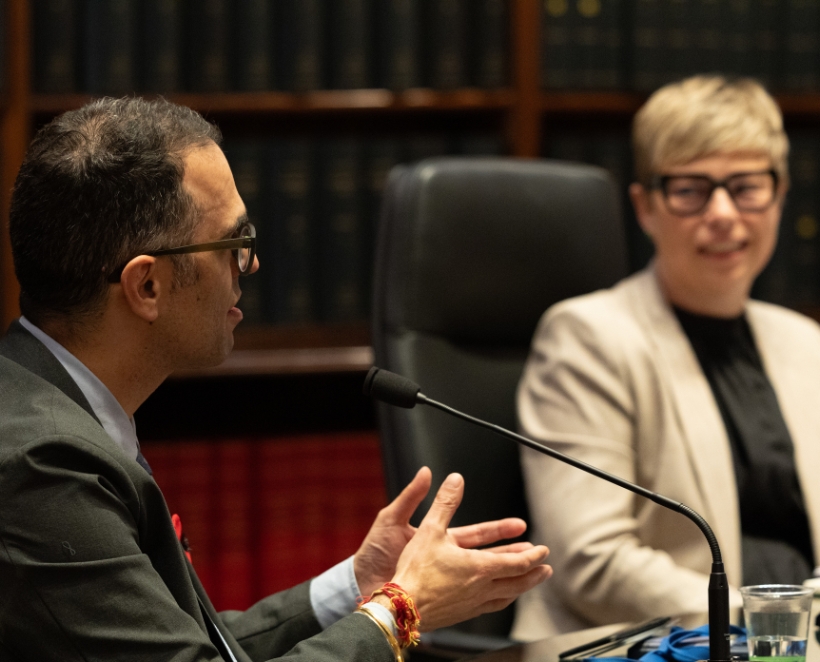

Every year, thousands of students walk through the doors of NSW Parliament House to learn how democracy works, meet the people who represent them, and experience Parliament of NSW firsthand. Helping to make those experiences meaningful is Joseph Cho, Senior Education Officer in the Education and Engagement team.
Joseph has worked with students from across NSW through programs like Legal Studies and the Legislature, Secondary Schools Student Leadership Program and Visit Us at Our House, helping to build young people’s understanding of democracy, civic participation and the role of Parliament of NSW in public life.
“Essentially, my job is to talk about our Parliament and the system of parliamentary democracy we have in New South Wales to anyone who is willing to listen,” he says.
Joseph believes giving young people the opportunity to experience Parliament in person plays an important role in building confidence in democratic institutions.
“Concepts like democracy, law, and Parliament can be quite abstract and theoretical,” he says. “They’re not the most exciting topics on paper. But when students come into Parliament House, they can see where democracy happens. It gives us a way to have those conversations without being preachy or patronising.”
NSW Parliament House itself plays an important role in that learning experience. As Australia’s oldest continuously operating public building, it has developed alongside the state’s democratic system, providing students with a tangible connection to history and government.
For many students, a visit is also their first chance to meet the elected representatives who serve their communities.
“One of the things we can do as the Education team is broker conversations between young people and Members,” Joseph said. “Members take that part of their job seriously and nine times out of ten they agree to meet students. It’s a really valuable opportunity for young people to engage directly with the people who represent them.”
Joseph’s career at Parliament of NSW began in the Legislative Council Committees Office. Holding a combined Arts and Law degree, he had long been interested in both public service and education. When an opportunity arose to join the Education and Engagement team in 2022, it presented the chance to combine those interests while helping young people better understand Parliament and democracy.
While programs such as Legal Studies and the Legislature, Secondary Schools Student Leadership, and Visit Us At Our House provide students with knowledge about Parliament of NSW, Joseph believes their greatest value lies in building confidence.
“Once you’ve been here, you realise Parliament isn’t some inaccessible ivory tower,” he says. “It’s the people’s house, and that’s how it should be. When students become familiar with the environment, they feel more confident returning and engaging with the democratic process in the future.”
Looking back on the past year, Joseph says one of the highlights has been the continued growth of NSW Parliament House’s education programs.
“We consistently receive really positive feedback, and participation continues to grow. Seeing those programs improve and knowing they’re valued by teachers and students is a real highlight.”
Another key achievement has been an increased focus on outreach to regional NSW.
“For a long time, travelling to regional communities was something on our wish list, but resource constraints and COVID made that difficult,” he said. “In the last year we’ve been able to do a lot more of that, which has been great to see.”
The establishment of Parliament of NSW’s Education Advisory Group has also helped strengthen the team’s work. Bringing together teachers, curriculum experts and education stakeholders, the group provides feedback on education programs and resources to ensure they remain relevant and effective.
“It’s helping us become more professional as a team and ensuring what we deliver continues to meet the needs of students and educators.”
Although much of Joseph’s role involves teaching, he says he learns just as much from the young people he meets.
“People often assume younger generations are disengaged, but I don’t find that at all,” he said. “They’re just engaging differently. They may not be reading newspapers or watching the 6 o’clock news like the generations before, but they get the information in other – you could say arguably faster – ways.”
Having grown up as a first-generation migrant from South Korea and spent much of his life in large cities, Joseph particularly values hearing perspectives from students in regional and rural communities.
“Whenever I meet people from different parts of New South Wales – particularly people who have come from the regions – I find the experiences and perspectives to be quite different to mine, but refreshingly, so,” he says.
For Joseph, meaningful participation in democracy involves more than simply encouraging young people to vote or ask questions. It is about giving them the knowledge, confidence, and skills needed to participate effectively.
“One of the most important skills we can teach young people is how to be comfortable with disagreement,” he said.
“Democracy isn’t about everyone agreeing. It’s about being able to discuss different views respectfully and find a way forward together.”
His passion for civic education is also shaped by his own experience growing up in South Korea during the 1990s, when the country’s democracy was still relatively young.
“I know democracy isn’t perfect, and I understand why people become frustrated with it,” he said. “But I’d choose it over any other form of government every time.”
At the end of many school programs, Joseph has gotten into the habit of sharing two facts with students: only a small proportion of the world’s population lives in a full democracy, and when New South Wales held its first democratic election in 1843, many people, including women, Aboriginal people and men who weren’t wealthy, could not vote.
“All of that changed because previous generations decided to do something about it,” he says. “So, I guess that’s my way of saying that the future of democracy is very much up to us.”
His message to young people is simple:
“Stay engaged. Democracy works best when citizens are informed and participate.”
This article was written by Frances Cordaro, Communications, Engagement and Education, Department of Parliamentary Services and originally published in