
Learning Outcomes
- HI5-SOU-01 Integrates evidence from sources to develop historical accounts, explanations and arguments about the past
- HI5-INQ-01 Assesses the value and limitations of sources as part of a historical inquiry
Syllabus Links
History 7 – 10 Syllabus (2024, implementation 2027)
Stage 5 – Depth Study (core): Australia: Making a Nation – from Federation to WWI (1889 – c. 1919)
- Nature, commemoration and perspectives of the Anzac legend
Remembering the fallen
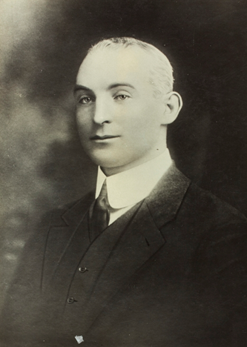
When George Braund and Edward Larkin died on the shores of Gallipoli they were only two of over 2,000 Australian soldiers killed in the first month of fighting.
 |
 |
By the time the ANZACs evacuated Gallipoli in December 1915, over 8,000 Australians had died. By the end of the war, Australian Prime Minister Billy Hughes spoke at the Paris Peace Conference in 1919, famously stating: “I speak for sixty thousand dead.” Each of those 60,000 Australians were remembered in several ways, with memorial cenotaphs being a common method in cities and towns alike for commemoration of the fallen. In the NSW Parliament, a permanent memorial was also erected.


On 11 August 1915, the Speaker of the NSW Legislative Assembly, Richard Meagher, had directed the house to have a bronze monument cast in memory of George Braund and Edward Larkin. On 30 November 1915, a large crowd gathered in the Legislative Assembly chamber for the unveiling of the memorial plaque to the two fallen members of Parliament. Premier Holman spoke of the unprecedented occasion which they were all a part of which “has never before arisen in the history of our country”. He continued to say that the two men were “the first public men in Australia to offer themselves to the cause of the Empire, and they were actually the first to fall in that same cause.”

To unveil the memorial plaque, Speaker Meagher noted that it was the “first permanent memorial to adorn the walls of this chamber” which had been built 72 years earlier. He also said that “its location seems most appropriate, supported on the one side by the oil painting of the Father of our Constitution, William Charles Wentworth… whilst it is supported on the other side of the oil painting of the Nestor of Australian politics, the late Sir Henry Parkes, who did so much towards crystallising the ideal of Australian nationality.”
The text of the memorial plaque:
In enduring remembrance of Lieutenant-Colonel George Frederick Braund and Sergeant Edward Rennix Larkin.
Representatives of Armidale and Willoughby in the Parliament of New South Wales. Who being the first amongst the Legislators of Australia to Volunteer for Service with the Australian Imperial Force in the Great War, fell gloriously in action at the Dardanelles in the month of May 1915.
This tablet is by direction of the Legislative Assembly of New South Wales erected.
The Hon. R.D. Meagher – Speaker
W.S. Mowle – Clerk of the House
In time of peace they worthily asserted the rights of citizenship.
In time of war fearlessly protected them.
Analysing the Memorial Plaque

The memorial plaque notes that George Braund and Edward Larkin both died in May. We know for certain that George Braund was killed in the early hours of 4 May by an Australian sentry. This is recorded by several witnesses as well as Braund’s official war record. However, Edward Larkin’s exact fate was not as accurately understood at the time. Due to the nature of fighting, Larkin’s body was not recovered until an armistice in May with the opposing Turkish forces. It was not until mid-June 1915 that Edward Larkin’s death was reported in Australian newspapers. As such, there was a general assumption that he must have died in May as his body was formally identified on 24 May.
When the memorial plaque for the Legislative Assembly chamber was being created, the general understanding was that both soldiers had died in May. However, according to Charles Bean, Australia’s official war correspondent during the war, Edward Larkin was killed on the day of the Gallipoli landing. Larkin’s official war record also states that he was killed in action on 25 April 1915. We can therefore be quite certain that Edward Larkin died on this day.
The NSW Parliament Honour Roll
On Wednesday 27 February 1918, a roll of honour was unveiled at the NSW Parliament to recognise the members of Parliament and members of staff who had served in the First World War. The idea had first been raised in January 1916, after several members and staff had already volunteered to serve with the Australian Imperial Forces. By the time it was unveiled, the war had been going on for nearly four years. Whilst those in attendance didn’t know it, the war would be over by the end of the year. The roll of honour was unveiled with the Premier, the Speaker, and the President in attendance. Following this, the Band of the New South Wales Police played the national anthem, which at the time was ‘God Save the King’.
The Roll of Honour features 26 names. They are evenly split, with 13 members of Parliament having served in the war and 13 members of staff having also served. All of the members of staff who enlisted survived the war. Below each of the names there is the following text:
On the altar of their country’s good they laid the incense of their fortunes and their lives.

Initially, the honour roll was designed with a view to having a more permanent work to replace it at a later date. The original had been designed by the Government Printing Office. It was suggested that a bronze memorial should be cast and placed in the Parliamentary library. However, due to the cost involved, it was never created. The ‘temporary’ honour roll has been hanging in the Parliament ever since!
Today, the memorial plaque and the roll of honour both remain on display in the Parliament of New South Wales. They are a continuous reminder of the sacrifices made by the people of the Parliament in the First World War.


