
Learning Outcomes
- LST-11-01 describes legal principles and judicial processes used in the legal system
- LST-11-02 explains the key features of Australian and international law
- LST-11-03 explains the role, formation and reform of law
What is Statute law?
Law-making in New South Wales is similar to the process in most other Australian states, the Australian Federal Parliament and the British Parliament, where there is a bicameral or two house Parliament. Under a bicameral system, bills (or proposed laws) pass through several stages in both Houses of Parliament, before being sent to the Governor for assent. Bills that have received assent are known as acts. Statute law (statutes) are made by Parliament
- Statutes made by Parliament prevail over Common Law (judge-made law)
- Statutes can alter Common Law
- Statutes are documents containing rules that have been voted on and approved by both Houses of Parliament and given royal assent
- A piece of legislation approved by the Parliament is also known as an Act e.g. The Law Enforcement (Powers and Responsibilities) Act 2002
Introduction of a Bill
Many (but not all) Acts are initiated by the political party that is in government. When the Government is satisfied that laws are needed, usually the Minister concerned submits the proposal to the Cabinet for approval and a bill is drafted by the expert drafters. The party room is where Bills will be discussed with all members of the party. A bill can be introduced in either House but must pass both to become a law.

Passage of a Bill
Before a bill is introduced into Parliament the Minister or private member introducing it gives notice of their intention to introduce the bill. Copies of the bill are distributed and published on the Parliament’s website here.
Bills can be introduced in both Houses. In the below example, it has been introduced in the Legislative Assembly. Once it has gone through three stages, it is forwarded to the Legislative Council.
The Council will also read the bill in three stages and may agree to the Bill without amendment and forward it to the Governor for assent. However, it may return the Bill with amendments for the Assembly’s consideration or it may not pass it.
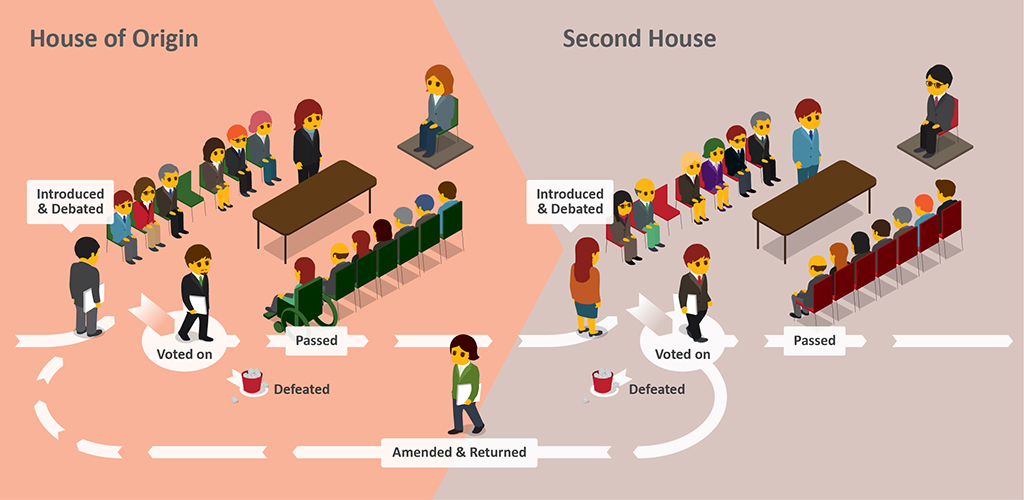
See Making Laws – The Legislative Assembly for a detailed summary of the passage of a bill
Royal Assent
This is the final stage in the process by which a Bill becomes an Act. Once it has passed through all stages in both Houses, the Governor must sign it before it can become law. This process is called assent. An Act will come into force 28 days after the Governor’s signature unless the Act specifies an alternative date.

Delegated Legislation
Sometimes Acts only outline broad guidelines or principles, leaving details to be defined later in regulations made through a Minister (example – traffic or planning laws). Through the authority of an Act of Parliament, power can be handed over to Ministers or other executive office-holders to make regulations. These regulations are also known as delegated legislation and different types include:
- regulations
- by-laws
- ordinances
- orders in council
- various other ‘instruments’ made by the Executive that fill in the detail of a law
The flexibility of delegated legislation is useful in matters that change regularly. However, these benefits may come at the cost of reduced parliamentary scrutiny. In some cases regulation can be disallowed by the Parliament. To learn more about this process we recommend the Legislative Council’s blog on the process. You can also read this Parliamentary Education blog.

Further learning links
Further Learning Links:
Use the attached further learning tasks to assess and expand students’ knowledge and understanding of Statutes and the steps in the legislative process


