
Learning Outcomes
- HS3 – DEM-01 Describe the origins and features of Australia’s democratic system of government and laws
- HS3-HIS-01 Examines and describes the development of Australian colonies and Australia as a nation
- Visual Arts - Investigate the way artists represent their world through the subject matter
- Visual Arts - Communicates about the ways in which subject matter is represented in artworks.
Syllabus Links
Human Society and its Environment K-6 (2024) – Stage 3
Historical sources present perspectives on the past
- HS3 – DEM-01 Describe the origins and features of Australia’s democratic system of government and laws
- HS3-HIS-01 Examines and describes the development of Australian colonies and Australia as a nation
Content
People have developed Australia as a nation
- Describe significant events and people that led to Australia becoming a federated nation on 1 January 1901, using sources as evidence
- Identify the purpose of Australia’s Constitution
- Research and describe the work of individuals who have made a significant contribution to the Commonwealth of Australia since Federation
People in Australia have democratic roles and responsibilities
- Describe the origins and values underpinning Australia’s bicameral parliamentary system of government
- Describe how bills are passed through Parliament to make a law
- Describe the roles and responsibilities of 3 levels of government in Australia
- Describe the ways people can participate in democracy in Australia
- Research how voting rights for Aboriginal and Torres Strait Islander Peoples and women were obtained in Australia using timelines to sequence key events
K–6 Creative Arts K–6 Syllabus (2024, implementation 2027) – Visual Arts
Appreciating involves students investigating the way artists represent their world through subject matter and ideas in their art making practices. Students critique artworks and have opportunities to communicate ideas about artists, artworks, the world and audiences. They develop an understanding that audiences may interpret art works in various ways.
First Female Member of the NSW Legislative Assembly
Millicent Preston-Stanley was born in 1883.
In 1925 she was elected as the member for Eastern Suburbs in the NSW Legislative Assembly. She was the first female Member of the NSW Parliament. She was only the second woman to become a Member of an Australian Parliament. Edith Cowan in Western Australia was the first in 1921 when she was elected to the Parliament of Western Australia.
Millicent Preston-Stanley was a feminist, and she advocated for the rights of women and children both when she was a member of parliament and throughout her life.
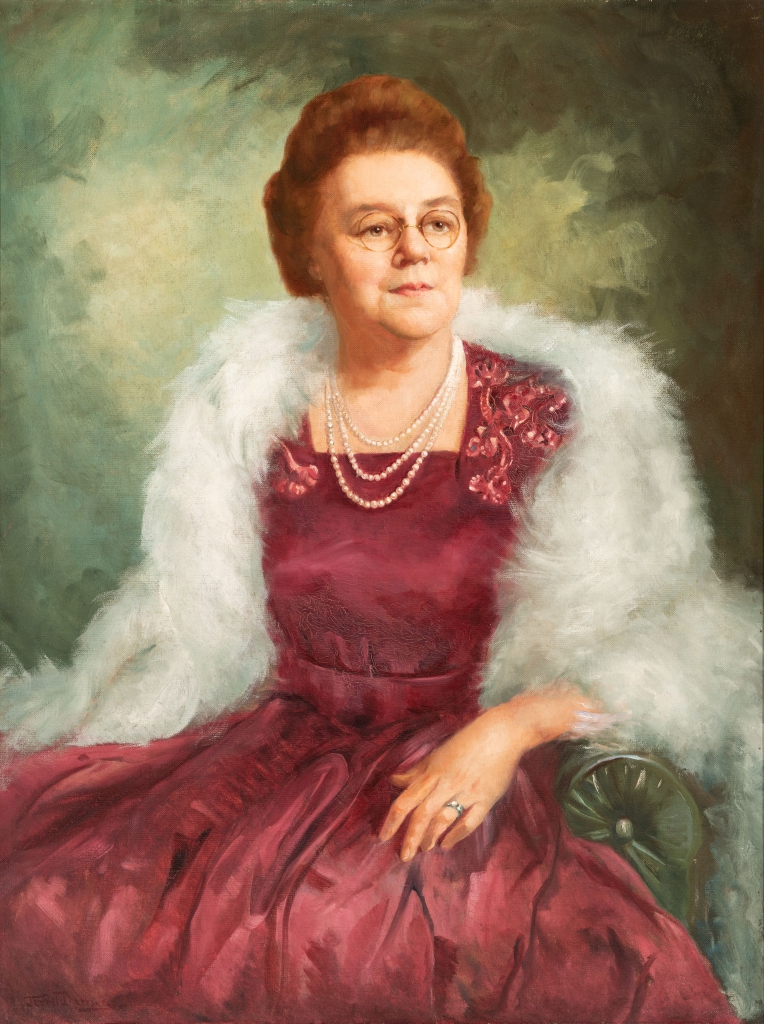
Below are two portraits of Millicent Preston-Stanley.
The portrait on the left is on display in the NSW Parliament. This portrait was painted in 1951 by Reginald Jerrold-Nathan and was presented to the NSW Parliament by the citizens of Sydney in December 1951.
The portrait on the right is on display in the NSW State Library. It was painted by Mary Edwards who was a finalist in the 1950 Archibald Prize with this portrait. (State Library of New South Wales Call No: DG 396). Two years later Edwards added a pair of blue spectacles to the portrait, to match those the sitter then wore. The update was made in time for the reopening of the Feminist Club of which Stanley was the new president.

Millicent Preston-Stanley’s work as a Member of Parliament from 1925 to 1927
As a member of the NSW Parliament, and the first ever female member, Preston-Stanley played a unique role.
She campaigned to reduce the number of women that died in childbirth. She wanted to make changes to child welfare laws to better protect children, and to the Health Act, to give women and children better access to doctors and hospitals. She also called for better housing for working families. She was critical of Premier Jack Lang for changing the law so that only mothers with dependent children could get the widows’ pension.
In her time in Parliament, she introduced a bill to allow mothers to keep guardianship of their children if they separated from the children’s father.
In the Australian Dictionary of Biography, she is described as:
“… a fine platform performer, adroit at turning hecklers’ remarks: called a battle-axe, she retorted ‘a battle-axe is a pretty useful weapon if it’s kept sharp and bright’. (Source Australian Dictionary of Biography)
Guardianship of Infants Bill
Preston-Stanley introduced the Guardianship of Infants Bill into Parliament in 1926 when she was part of the opposition.
The Bill was based on the experiences of a woman called Emelie Polini who had lost custody of her child when she separated from her husband and needed to travel to Britain for work.
Preston-Stanley, and many women across NSW, wanted the Government to introduce an Act to give mother and father equal rights in custody. This was the purpose of Millicent’s bill which was not successful.
When she left Parliament Preston-Stanley wrote and starred in a play called Whose Child? based on Emelie Polini’s story. She performed as herself as a member of parliament. The play was staged at the Criterion Theatre in 1932 and was attended by many influential people including the NSW Governor.
The Guardianship of Infants Act was eventually passed in 1934.
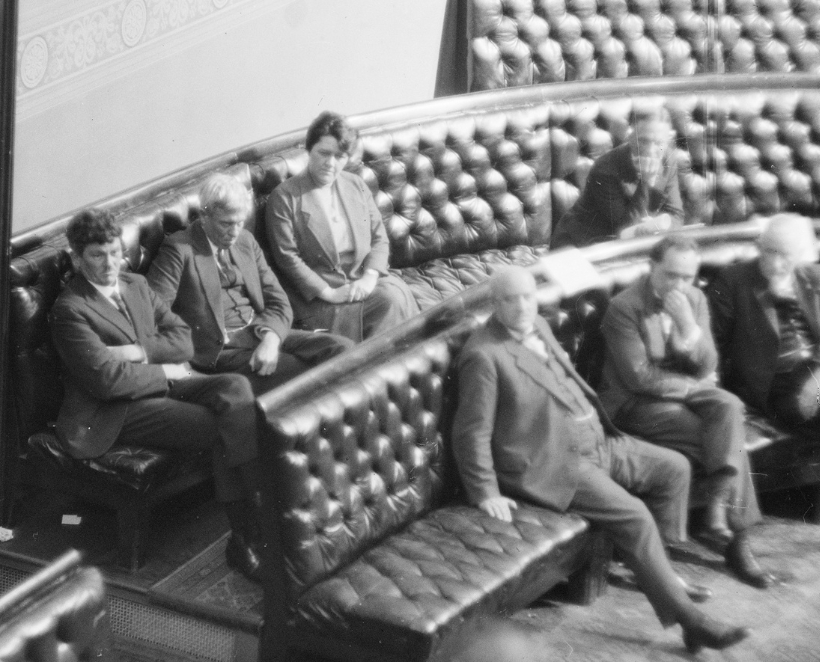
Millicent Preston-Stanley in the NSW Legislative Assembly
This photo was taken by a Hansard Reporter during a parliamentary sitting day in the time when Millicent Preston-Stanley was a Member of Parliament (1925 – 1927)
Timeline: Events in Millicent Preston-Stanley's Life
YEAR |
LIFE EVENT |
| 1883 | Born in Sydney, NSW. She was the eldest of three children of Augustine Gregory Stanley, Sydney-born grocer, and Fanny Helen, née Preston. |
| 1895 | Her father deserted the family. Because of this her mother was granted a divorce. They lived at Surry Hills, then Paddington. Preston-Stanley was educated privately. |
| 1905 – 1915 |
Between the ages of 23 and 32, she worked for the Women’s Liberal League, organising talks, educational events with mock elections and debates and musical evenings. In one of her speeches, she proposed an entertainment tax to finance hospitals. In 1913 she unofficially attended lectures in economics at Sydney University with her brother. She also went on a lecture tour of the USA in 1915. |
| 1916 – 1925 Preston-Stanley |
Preston-Stanley became president of the Feminist Club from 1919 where she organised events to educate women about politics. From 1918 to 1920 she worked for the Nationalist Party in New South Wales and Queensland. During these years she also worked as a company director of a real estate firm- in this role she was responsible for making important decisions about the business. She was also an organiser for the New South Wales Temperance Alliance which was an organisation that wanted people to drink less alcohol and limit the amount of alcohol that could be sold. She was also the president of other organisations that were interested in the welfare of women and children. She became a justice of the peace in 1921, one of the first women appointed. She was president of the New South Wales Women Justices Association from 1923 to 26. She stood for the State seat of Eastern Suburbs in 1922 but didn’t win. |
| 1925 – 1927 |
Preston-Stanley stood for the multi-member seat of Eastern Suburbs at the 1925 state election and was elected to the NSW Legislative Assembly. She stood again in the 1927 state election but did not win. |
| 1927 – 1955 |
After she left Parliament, Millicent Preston-Stanley continued to work to improve the lives of women and children. She worked in many organisations that were concerned about the welfare and rights of women and children including the Australian Federal Women Voters, the Girl Guides, the Save The Children Fund and many others. Millicent Preston-Stanley died in 1955. |
Did you know?
Women in NSW won the right to vote in 1902 but weren't allowed to stand for election
In 1902, after a long campaign to win the vote, women were allowed to vote at both Federal and State elections.
In addition, women could stand for election to the Federal Parliament, but they could not be elected to the State Parliament.
This was because there were different laws that were made in the different parliaments – one law for the state of NSW and another law for the whole of Australia. So, for state elections in NSW, it wasn’t until another law was passed in the NSW Parliament that allowed women to stand for the state parliament, that they could be elected. This law was called the NSW Women’s Legal Status Act and was passed by the NSW Parliament in 1918. Finally, women in NSW could be elected to their state parliament.
This law also allowed women to become lawyers. Before this, women could study law at university, but they couldn’t practise as a lawyer.
An example: Ada Emily Evans, BA, LLB, University of Sydney, 1902
In 1902, Ada Evans, had qualified in law from the Law School of the University of Sydney but she was not admitted to practise under the NSW Legal Practitioner’s Act.

For many years Ada Evans and many other women in NSW wrote letters to the NSW Attorney-General asking for the law to be changed. A Bill to do this was introduced to the NSW Parliament in 1916 but was not passed. Another Bill was introduced to Parliament in 1918 and this time it was passed stating that women could now become lawyers. This became the NSW Women’s Legal Status Act. This was good news for Ada Evans who could now work as a lawyer in NSW.
The NSW Women’s Legal Status Act also allowed women to be elected to the NSW Parliament but only to the Legislative Assembly. This meant that a few years later, in 1925, Millicent Preston-Stanley could stand for election and become the first female member of parliament in NSW.
It wasn’t until 1926 that the Act was changed so that women could be appointed to the Legislative Council. Only the Legislative Assembly was an elected House at this stage. The first two female Members of the Legislative Council were – Catherine Green, and Ellen Webster who were appointed in 1931.


