

Did you know?
That there are hundreds of lions in the parliamentary precinct.
Well, representations of lions.
On a quick count, parliamentary education officers discovered over 200 representations of lions. We spotted more than 40 of them lurking in the Legislative Assembly chamber, high up near the ceiling, forming part of the decorative stencilled border.

But most of the lions appeared on doors, tapestries, photo boards, bread plates, dinner plates, cups, business cards and directional signage.

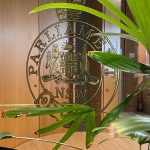

Never fear, though! All of these lions were safely enclosed within the parliamentary crest.

But one stood out, proudly three dimensional, in salient pose, sculpted in gold on the top of the black rod. The black rod is a symbol of authority placed in the Legislative Council chamber by the Usher of the Black Rod during each sitting day. The lion holds up the NSW parliament shield with the coat of arms on it, which also depicts a lion.

On the NSW coat of arms, a lion and a kangaroo hold up the shield.
New South Wales was granted its coat of arms in 1906. Its emblems speak both of our connections to Britain and of our unique Australian identity. The small lion at the centre of the shield (lion passant guardant), and the large lion supporting the shield on the left (lion rampant guardant), represent ties to Britain. Our Australian identity is symbolised by the kangaroo supporting the shield on the right, while the golden fleece and sheaves of wheat represent our successful wool industry and agricultural wealth. The star represents the Southern Cross and hope for the State’s future is symbolised by the rising sun.
The Latin motto, Orta recens quam pura nites, translates as Newly risen how brightly you shine, a reference to the new colony.

Our lion representations were found in three poses: rampant, salient and passant guardant.

The “lion rampant” is a historic heraldic symbol featuring a red lion standing on its hind legs with raised claws on a gold field. It represents courage and nobility.

A “lion salient” is leaping, with both hind legs together on the ground and both forelegs together in the air.

A “lion passant” is walking, with the right fore paw raised and all others on the ground. When its face is turned towards the viewer it is also guardant.
However, we were quite relived when we did not find a single real-life lion anywhere on the parliamentary premises.
When you next visit parliament, feel free to conduct your very own lion safari and try to spot all the legislative lions in their parliamentary lairs.
A NOTE ON THE PARLIAMENTARY CREST:
CAN YOU SPOT THE DIFFERENCE?

The NSW Parliament recently updated its crest due to the accession of King Charles III and also to accomodate recent updates to the NSW State Arms.
The new crest incorporates the Tudor Crown, whereas the old crest used St Edward’s Crown.

Items and heraldic representation created during Queen Elizabeth II’s reign featured the St Edward’s Crown. New items or heraldry now feature the Tudor Crown, chosen by King Charles III. Both crests are official and mark a moment of transition in Australia’s constitutional history.


