
Learning Outcomes
- HI5-IEP-01 Explain how significant ideas and events have shaped the past
Syllabus Links
History 7 – 10 Syllabus (2024, implementation 2027)
Stage 5 – Depth Study (core): Australia: Making a Nation – from Federation to WWI (1889 – c. 1919)
- Reasons for Australia’s involvement in WWI
- The Australian Response to WWI, including the Gallipoli Campaign
- Battles in which Australians fought in WWI
Legislators at War
When Britain declared war on Germany on 4 August 1914, Australia was also at war, having immediately supported Britain because of their strong kinship ties. Over the next four years, more than 400,000 Australians out of a population of nearly 5 million enlisted for service. Among those were 13 members of the NSW Parliament. Eleven were from the Legislative Assembly whilst two came from the Legislative Council. Many of these men saw it as their duty as representatives of their local area to also serve their nation in a time of war. Most were also very loyal to the British Empire and wanted to assist their war effort.
George Braund and Edward Larkin were the first to enlist for active service. Before they left, Speaker Richard Meagher farewelled them in the Legislative Assembly chamber:
“We know that both Lt.-Colonel Braund and Sergeant Larkin will fight like Australians, and, if need be, die like Australians, but we pray that Providence will spare them to return to this sunny soil that gave both of them birth.”
 |
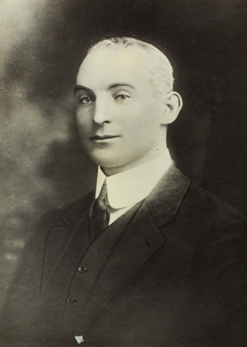 |

Members of Parliament who enlisted in World War I
Legislative Assembly
|
Member |
Electorate |
Age at Enlistment |
Service Years |
|
George Frederick Braund |
Armidale |
48 |
1914-1915 |
|
Edward Rennix Larkin |
Willoughby |
34 |
1914-1915 |
|
Frank Augustus Chaffey |
Tamworth |
27 |
1915-1919 |
|
Charles Stuart Fern |
Cobar |
30 |
1915-1916 |
|
James William Macarthur-Onslow |
Bondi |
47 |
1915-1917 |
|
Charles Edward Nicholson |
Maitland |
61* |
1915-1917 |
|
Thomas Henley |
Burwood |
55 |
1915-1919 |
|
Ambrose Campbell Carmichael |
Leichhardt |
45 |
1916-1919 |
|
William Fraser Dunn |
Mudgee |
39 |
1916-1918 |
|
George Cann |
Canterbury |
45 |
1916-1917 |
|
James Guy Dalley Arkins |
Castlereagh |
27 |
1916-1919 |
*There are conflicting sources for the date of birth for Charles Nicholson. His enlistment papers say 61 years 8 months.
Legislative Council
|
Member |
Appointed to Council |
Age at Enlistment |
Service Years |
|
Dr. John Brady Nash |
12 June 1900 |
57 |
1914 |
|
Dr. Joseph Lievesley Beeston |
21 July 1908 |
55 |
1914 |
Where did the Members serve?
Egypt
The first Australian soldiers to enlist were expecting to find themselves in Europe to fight against the Germans. However, they instead found themselves in Egypt in December 1914. The soldiers of the Australian and New Zealand Army Corps trained in the deserts of Egypt under the shadow of the pyramids until March 1915. The men soon came to be known as the ANZAC’s.
Whilst they were in Egypt, three members of the NSW Parliament reunited and were photographed together. Sitting on a donkey in the image below is Lieutenant-Colonel George Braund. He had been given command of the 2nd Battalion, which meant he was responsible for up to 1000 Australian soldiers. Next to him on one side was Sergeant Edward Larkin who was in command of a section of up to 16 soldiers. On the other side was Lieutenant-Colonel Dr. John Brady Nash who served with the Army Medical Corps. Whilst the others went to Gallipoli, Dr. Nash stayed in Egypt to look after any sick soldiers.

Three members of Parliament on active service. Identified from left to right: 321 Sergeant Edward Rennix Larkin, 1st Battalion from Neutral Bay, NSW, Secretary and Member of Legislative Assembly of NSW (killed in action on 25 April 1915 at Gallipoli); mounted on the donkey is Lieutenant Colonel George Frederick Braund, Commanding Officer of the 2nd Battalion from Neutral Bay, Member of the Legislative Assembly of NSW (killed in action on 4 May 1915 at Gallipoli); and Lieutenant Colonel John Brady Nash, 2nd Australian General Hospital (2 AGH) from Sydney, surgeon and Member of the NSW Legislative Council.
What happened to Braund and Larkin at Gallipoli?
At dawn on 25 April 1915, nearly 16,000 ANZAC soldiers landed at Gaba Tepe (later renamed Anzac Cove) in Gallipoli. By the end of the day, about 2,000 (1 in 8) were either dead or wounded. In the evening, some men of the 1st Battalion were returning from an advance when they discovered the “savagely slashed body” of an Australian soldier. It was Edward Rennix Larkin. However, due to the fighting his body wasn’t recovered for another month. Tragically, his brother Martin ‘Paddy’ Larkin was also killed on the day of the landing. The Larkin brothers have no known grave.
George Braund and his Battalion spent three days on the hills of Gallipoli before they were given some rest on the beach. A few days later, Braund and his men returned to fight. At 1am on 4 May, an Australian sentry noticed someone beyond the picket lines. Having received no reply, the sentry fired a shot at the figure, expecting it to be a Turkish soldier. Instead, lying face down and with a bullet through his head, was Lieutenant-Colonel George Frederick Braund. The Member for Armidale had been the first Australian member of Parliament to enlist upon the outbreak of the war. He now lay among Australia’s war dead.
In the opening day of the Gallipoli campaign, over 2,000 Australians were either killed or wounded. The medical teams could not keep up with the number of soldiers coming through their tents. They often worked through the night to save the lives of several men.

Dr. Joseph Beeston was on the shores of Gallipoli attending to the soldiers who had been injured in the landings. His makeshift hospital on the beach was created with tents, and he would often operate whilst artillery shells flew above and beside him. On one occasion, Dr. Beeston and his staff received 51 casualties in 45 minutes. After returning to Australia, he would later write a book on his experiences called ‘Five Months at Anzac‘.

The Gallipoli campaign was largely unsuccessful for the ANZAC’s. In fact, the retreat is often considered the most successful part. Part of the evacuation from Gallipoli featured a Cricket match which was used to make the Turkish soldiers believe that the ANZAC’s were staying longer. The match was organised by Major George Macarthur-Onslow, brother of James Macarthur-Onslow who was the member for Bondi.
Why did other members enlist?
It took more than a month for news of the dead soldier-legislators to reach Australian shores. However, after hearing about the fate of George Braund and Edward Larkin, six more members of Parliament enlisted for service within the next five months.
- Frank Chaffey, the member for Tamworth, was particularly affected by the death of George Braund who was from nearby Armidale. He now believed that young men who were physically fit should volunteer themselves for service overseas.
- Charles Fern, the member for Cobar, had been an enthusiastic recruiter for the war and encouraged men to enlist. He hid the fact that he had tuberculosis (a disease of the lungs) when enlisting, otherwise he would have been rejected.
- James Macarthur-Onslow, the member for Bondi, was in his late 40s and was a veteran of the Second Boer War. His age would have made him exempt from service, but he responded without delay when it was suggested that his services might be of assistance to the Empire.
- Charles Nicholson, the member for Maitland, had retired from military service in February 1914 after 26 years of honourable and distinguished service. He saw it as his duty to come out of retirement and serve his nation in an hour of need. At the age of 61, Nicholson was not going to be in the trenches of Gallipoli, but he offered his services to transport soldiers on the troopships from Australia to Europe.
- Thomas Henley, the member for Burwood, assisted the war effort in a different way, working with the Citizen’s War Chest fund in Alexandria, Egypt. He helped to distribute goods and comforts to the Australian soldiers where they were fighting. Henley described himself as “acting in the capacity of Father Christmas” to the Australian troops.
- Ambrose Carmichael, the member for Leichhardt, set himself the ambitious target of recruiting 1,000 men by himself. He achieved this by going to the local rifle clubs and encouraging them to enlist. The 36th Battalion came to be known as Carmichael’s 1000. A song, titled ‘When “Captain Car” Goes Forth to War’, was also produced.

Miss Evelyn Shaw composed a song to celebrate Ambrose Carmichael (‘Captain Car’). National Library of Australia, MUS N mba 783.2421599 S534
By early 1916, William Dunn (Mudgee), George Cann (Canterbury) and Guy Arkins (Castlereagh) had become the final three members to enlist for active service from the NSW Parliament.
Although 13 members of the NSW Parliament enlisted, not all of them contributed in the same way or in the same places. There were several different ways to contribute to the war effort as demonstrated by Guy Arkins, the member for Castlereagh. Arkins was opposed to war and did not believe in the killing of another human. However, he was patriotic and enlisted as a driver to transport soldiers around in dangerous sections of the French battlefields.
Other members, such as Ambrose Carmichael, were in the middle of the fighting. He was injured at Houplines in Northern France on 21 January 1917 and again at Broodseinde in Belgium as a part of the Battle of Passchendaele on 4 October 1917. Also on the sick list were George Cann, who fell sick with pneumonia, and William Dunn, who injured his knee after falling into a hole whilst walking along a trench. Cann saw very little of the war before being sent back to Australia, whilst Dunn had spent time on the Western Front in France before his injury.
The remaining members of the Legislative Assembly all returned to Australia. However, each of them had been changed by what they had experienced overseas. Charles Fern, the member for Cobar, returned with ‘Shell Shock’, a psychological injury we would now refer to as post-traumatic stress disorder (PTSD). Combined with the tuberculosis he already had, Charles Fern’s health declined and he died on 18 April 1918. The legislators of New South Wales had paid a heavy toll when compared to the other Australian Parliaments. In total, 32 members of Parliament across State and Federal levels enlisted whilst a sitting member of parliament. Sixteen came from New South Wales, whilst the other half came from Western Australia, Victoria, and South Australia. The only other to die was Bartholemew Stubbs, the member for Subiaco in Western Australia. He was killed in Belgium on 26 September 1917 at the Battle of Polygon Wood.


